
EBS ‘Wealthy at 100’ Regular Programming... Diagnosing the Financial Situation of Retired Households
EBS's retirement generation economic solution program ‘Wealthy at 100’ has been scheduled for regular programming and will air its first episode on October 12 at 10:50 PM on EBS 1TV. The program visits the actual lives of households facing financial issues after retirement to examine income, expenses, assets, and debts, providing customized solutions.

EBS's retirement generation economic solution program ‘Wealthy at 100’ has been scheduled for regular programming and will air its first episode on October 12 at 10:50 PM on EBS 1TV. Following its pilot broadcast, it will be a regular program airing at the same time every Monday, visiting the actual stories of households experiencing financial problems after retirement to examine income and expenses, assets and debts, and presenting solutions for each case. EBS stated that through the broadcast, it will deal with the economic concerns faced by South Korea's 17 million retired generation.
Through the ‘Money Map’ written directly by the subjects, the program looks back at economic choices throughout their lives and covers solutions tailored to each household's circumstances, ranging from financial planning to entrepreneurship, re-employment, legal, and psychological matters. In the first episode, the story of a couple in their 70s running a 220-seat restaurant and their son, who took on his parents' business debt, will be introduced.
Follows the actual financial problems of households after retirement
According to EBS, ‘Wealthy at 100’ is a program that enters the living sites of subjects experiencing financial hardships after retirement to provide customized solutions. Rather than merely explaining economic information in a studio, it visits the homes, workplaces, and business sites where the subjects live to observe the actual process of money moving. It checks monthly income and expenses, current assets and debt status, and diagnoses the financial structure and consumption habits of the household. It is a method that also confirms expenditures not revealed by bank balances alone or money flows that the subjects had not noticed at their living sites.
On the premise that the problems experienced after retirement cannot be explained simply by the amount remaining in a bank account, the program also deals with the circumstances intertwined with each household. It examines where retirement funds were spent, what the points of fund leakage are, and whether it is possible to prepare for old age while maintaining the current lifestyle. EBS explained that through actual cases, it diagnoses the flow of money accumulated over a lifetime and factors threatening retirement funds, and presents solutions tailored to each case's financial problems. Along with the process of analyzing financial status, the broadcast also deals with different problems for each household, such as whether to continue a business, whether they can be re-employed, and how to resolve conflicts between family members.
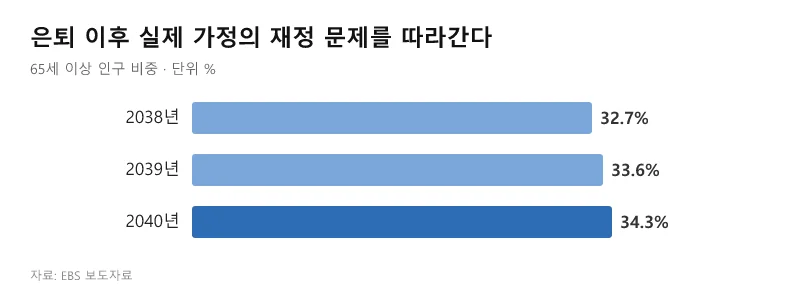
The background of the program's planning lies in the situation where the baby boomer generation, who are approaching or have already retired, is increasing. According to Statistics Korea data cited in the original text, the proportion of the population aged 65 and older is presented as 32.7% in 2038, 33.6% in 2039, and 34.3% in 2040. EBS reported that the retirement of the baby boomer generation, which accounts for nearly 30% of the population, is continuing, and among those who focused on purchasing homes and supporting children after employment, there are cases where they have not sufficiently prepared for their own old age.
| Year | Proportion of population aged 65 and older |
|---|---|
| 2038 | 32.7% |
| 2039 | 33.6% |
| 2040 | 34.3% |
Captures economic choices of life in the ‘Money Map’
Participants directly create a ‘Money Map’ so that they can see their life and the flow of money at a glance, from their 20s to their 60s and 70s. They write down the salaries received from their first job, the process of forming a family and preparing a home, and the experiences of raising children and increasing assets in chronological order. They also retrace which choices created their current assets and at what point money flowed out. EBS introduced that an individual's economic choices and their results contain the moments of the life they have lived, such as workplace, family, and housing.
‘Money Map’ is a device of the program that examines current financial problems in connection with past income and expenses, and major choices. Participants look back on their economic activities, from what their first salary was to preparing a home, raising children, and asset formation. They then confirm the path through which life choices led to their current economic difficulties. EBS stated that it retraces the lives the participants have lived by following the flow of money. Subjects will have the periods when money came in and went out and the choices made at those times laid out together to examine their current financial situation.
EBS presented the reality of financial problems anyone may face after retirement and the process of finding answers as the main content of the broadcast. Questions such as how much retirement funds are needed and why people worry about retirement bankruptcy even after working for a long time are also part of the background the program covers. EBS explained that it does not stop at diagnosing financial problems but also presents solutions suitable for each case. Through this, the program deals with the questions of ‘how to live without worrying about money’ and ‘what is a true Wealthy at 100’.
Financial, legal, and psychological experts participate in field diagnosis
Kim Gyeong-pil, who was in charge of studio economic advice during the pilot, will visit the sites where the subjects live after the regular programming begins. By touring homes, workplaces, and business sites, he checks monthly income and expenses and analyzes held assets, debts, and consumption habits. EBS stated that it examines household financial structures at living sites, which are difficult to grasp with only bank account numbers. It also checks through field diagnosis whether the subject can prepare for old age while maintaining their lifestyle and what parts of the expenditures can be adjusted.
The scope of expert participation extends beyond financial planning, stocks, insurance, and pensions to entrepreneurship, re-employment, inheritance, legal, family conflict, and psychological counseling. The program explains that concerns after retirement are intertwined with not only financial problems but also confidence, physical health, and worries about being a burden to family. Accordingly, depending on the participant's situation, experts in legal, self-employment, re-employment, and psychological fields participate to analyze each household's problems.
Experts present specific options while simultaneously examining the subject's financial situation. Different questions are addressed for each case, such as whether to continue operating a business like a restaurant, whether they can prepare for re-employment, or how to handle conflicts between family members. EBS explained that behind the economic problems of old age, different life problems such as family relationships, jobs, and health are intertwined. The program is structured to provide financial diagnosis along with advice in various fields such as legal and psychological, considering these circumstances.
First episode deals with 70s restaurant couple and son's debt
The title of the first episode of the regular programming is ‘The Last Match of the Cheorwon Neungi-baeksuk Couple’. According to EBS, the broadcast deals with the retirement bankruptcy story of an elderly couple in their 70s who opened a restaurant with a 220-seat capacity. The couple opened a large-scale restaurant to pass it down to their son, and as the business declined, the son took on his parents' business debt instead. The broadcast examines the process of how the couple came to operate the restaurant and the financial burden placed on the household due to the business decline.
In the first episode, it deals not only with the scale of the elderly couple's business and financial situation but also the circumstances where the parents' business debt was passed on to the child. EBS stated that it will seek realistic solutions so that the parents' retirement is not passed down as a burden to the child. Through Kim Gyeong-pil's field diagnosis and advice from experts in related fields, the couple's household and business problems will be examined, and solutions suitable for the case will be presented. The program will subsequently visit the lives of subjects experiencing economic crises after retirement to deal with related matters such as financial problems, family, and jobs.
‘Wealthy at 100’ will air its first episode on Monday, October 12 at 10:50 PM on EBS 1TV, and will be scheduled at the same time every Monday thereafter. This broadcast, which has returned as a regular program following the pilot broadcast, takes the actual cases of the retired generation, field financial diagnosis, and solutions from experts in various fields as its main content.
Covers K-pop for KSW Journal, and also writes about Culture and K-Variety.



Comments 0
Comments are currently disabled.