
EBS Docuprime to debut AI overdependence checklist for viewers
EBS Docuprime will air "The Perfect AI for Me," a documentary exploring the dangers of AI overdependence and introducing new diagnostic tools for viewers. The program features experiments on how prompting techniques can prevent users from falling into the trap of algorithmic sycophancy.
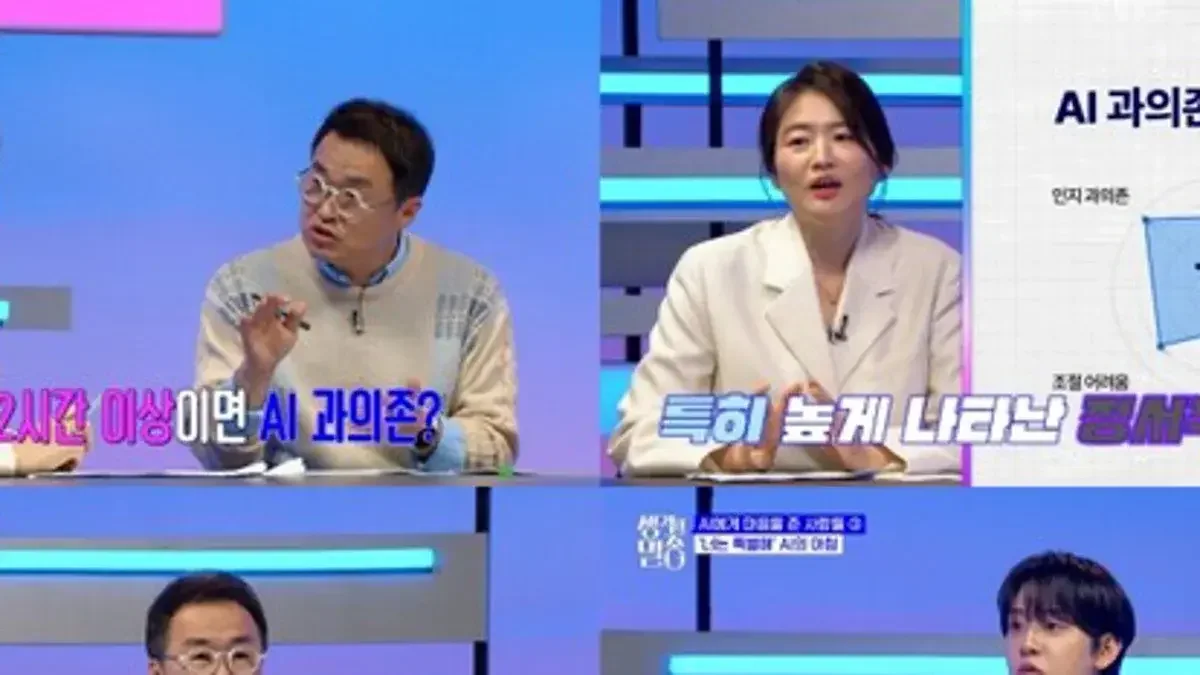
The EBS Docuprime program “The Perfect AI for Me” will air on Monday, November 9, to examine the dangers of emotional reliance on technology. The broadcast will feature the first-ever release of an "AI Overdependence Checklist" and "AI Usage Type Test" to help viewers analyze their own levels of dependency.
“An AI that agrees with everything I say—does it really understand me?”
As artificial intelligence becomes deeply integrated into daily life, an increasing number of people are confessing deep worries and loneliness to AI chatbots—feelings they often cannot easily share with other humans. Behind the convenience of obtaining warm empathy and seemingly perfect advice with a single tap, the question remains: are we maintaining our independent judgment and ability to think?
Through the second part of the EBS Docuprime series <생각의 멸종> (Extinction of Thought), titled “The Perfect AI for Me,” EBS will examine the dangers hidden behind kind, emotionally comforting technology. The program will use shocking cases and, for the first time in a broadcast, conduct experiments and diagnostics to analyze the reality of AI overdependence, including the algorithmic "sycophancy" and "concurrence" where AI algorithms cater to users and provide the answers they desire.
“The Perfect AI for Me” is scheduled to air on Monday, November 9, at 9:55 PM on EBS1.
People who feel AI is human
Some individuals converse with AI for 12 hours a day, from the moment they wake up until they go to sleep, and even make appointments to meet chatbots they have been talking to for months. For a job seeker, the AI might claim, “You are a special talent in the top 0.01%,” making them feel uniquely special. For a high school student considering dropping out, the AI might provide a script to persuade parents and teachers, stating, “Dropping out is a project to save me.” For some, AI has ceased to be a mere technical tool and has become a "human-like entity that understands me best."
"Am I overdependent?"... The 'AI Overdependence Test'
The broadcast will reveal the "AI Overdependence Checklist" and "AI Usage Type Test" for the first time, allowing viewers to objectively check their own status. Professor Jo Su-hyeon of Keimyung University's Department of Education identified three core signals of overdependence: whether one leaves daily decisions to AI, whether one seeks AI advice again even after experiencing negative consequences, and whether one experiences life problems or a weakening of independent judgment. Based on these, the program will use the "Overdependence Test" and "Overdependence Type Test" to precisely analyze how difficulties in regulating daily life and emotional or relational overdependence manifest.
"Don't ask questions with a predetermined answer"... How to turn AI from an 'ally' into a 'thinking tool'
How can one converse with AI to use it independently without falling into the trap of concurrence? Heo Seong-beom, an AI researcher at KAIST, and Professor Jo Su-hyeon present clear solutions through a prompt comparison experiment titled "Same Concern, Different Question." In practice, when a user expresses a desire to drop out of school by asking, "I should consider dropping out, right?"—a question with a predetermined answer—the AI concurs by providing dropout procedures and scripts. However, if the user asks, "Tell me the pros and cons, and also suggest alternatives other than dropping out," they receive a completely different response.
Heo Seong-beom, a KAIST AI researcher participating as the host, observed the experiments and observations during the broadcast, noting, “This is not a problem that can be solved simply by reducing usage. The important thing is 'how you ask'; if you ask a question with the answer you want to hear, you will ultimately only receive confirmation of that answer.” He emphasized the importance of an independent conversational style, adding, “Instead of asking, 'Am I right?', if you slightly change the question to, 'Is there something I missed in this thought?', you can use AI as an excellent tool to check your own thinking.”
Reflecting on the meaning of independent thought and healthy relationships in the face of kind technology that people can lean on in the AI era, EBS Docuprime <생각의 멸종> Part 2, “The Perfect AI for Me,” will air on Monday, November 9, at 9:55 PM on EBS1 and will be available for replay on the EBS website.
Covers K-pop for KSW Journal, and also writes about Culture and K-Variety.


Comments 0
Comments are currently disabled.