
EBS Docuprime: AI Sapiens explores Nobel Prize achievements and the unpredictability of artificial intelligence
The EBS documentary series "Docuprime: AI Sapiens" explores the dual nature of artificial intelligence, covering its revolutionary technological milestones and the growing concerns regarding its lack of human-like understanding and controllability.
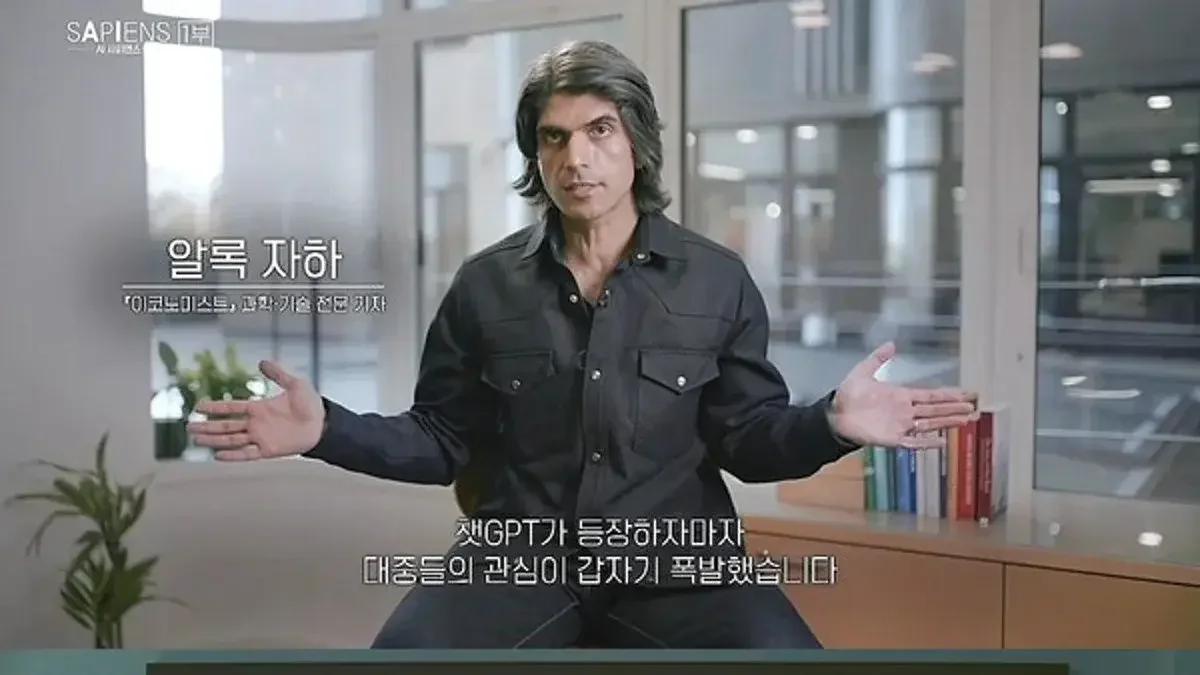
The EBS documentary series "Docuprime: AI Sapiens" presents the two faces of artificial intelligence—a technology that is simultaneously familiar and still foreign to us. The series introduces the intense first impression of the AI era, ranging from incredible achievements that led to Nobel Prizes to questions regarding the inability to control the technology.
The dazzling development of artificial intelligence was not an accident, but rather the result of a puzzle of the AI revolution completed by decades of accumulated technology and research. The series stimulates intellectual curiosity through the vivid stories of world-renowned scholars and interesting case studies, building anticipation for upcoming episodes.
The dual nature of artificial intelligence, which is familiar yet remains strange to us, has been revealed. In the first episode, "Alien Intelligence," which aired this past Monday the 23rd, the EBS documentary series "Docuprime: AI Sapiens" captured attention from its first broadcast by interestingly unfolding everything from the decisive moments that led to the advancement of AI to the possibilities of AI that exceed human expectations.
The broadcast highlighted the paper "Attention Is All You Need," published in 2017 by eight Google researchers, as the starting point of the AI revolution. Driven by the idea to do something before one of the researchers left the company, the group came together to create a groundbreaking idea. They developed "Transformer," a new artificial intelligence model structure centered on the "Attention" technique, which boldly removes complex language processing structures to focus on the relationships between words.
The fact that the resulting Transformer represents the "T" in ChatGPT—one of the generative artificial intelligence services developed by OpenAI that we use so familiarly today—realizes how innovative the discovery was at the time. Furthermore, the program revealed the presence of artificial intelligence permeating various aspects of our lives, including an anecdote where the world-renowned evolutionary biologist Richard Dawkins conceived an SF novel with the help of AI.
Meanwhile, the program also provided a glimpse into the turbulent history of artificial intelligence. AI research, which began with artificial neural networks mimicking the human brain, experienced a so-called "AI winter," where research and investment contracted due to results that fell short of expectations. However, the current golden age was reached as several conditions coincided perfectly, including the improvement of computer computing power, the accumulation of vast amounts of data, and the emergence of the Transformer.
Leveraging technological advancements, AI has achieved remarkable performance in various fields we were previously unaware of. In particular, the fact that the developers of AlphaFold, which achieved a breakthrough in solving the long-standing challenge of protein structure prediction, were awarded the Nobel Prize in Chemistry demonstrated the reality of artificial intelligence contributing to the advancement of science and medicine beyond merely answering questions and writing text.
On the other hand, new questions were raised in tandem with the rapid pace of development. Experts pointed out the limitations of artificial intelligence, explaining that AI does not understand the meaning of questions like a human, but rather produces plausible results based on patterns in the learned data. Furthermore, they warned of the uncertainty lurking behind the technology, mentioning the problem that even the developers who created the AI find it difficult to perfectly understand the process through which the AI derives its results.
Most notably, mathematician and computer scientist Stephen Wolfram and historian Yuval Harari drew attention by commonly comparing AI to "alien intelligence" due to the fact that it operates in a fundamentally different way from humans. This raises curiosity about how far humanity can understand this strange intelligence and how long we can control it.
In this way, "Docuprime: AI Sapiens" increases immersion by explaining the history and technical principles of artificial intelligence, which could otherwise feel difficult, through interesting examples and the stories of world-renowned scholars. In particular, the massive changes brought by AI and the challenges facing humanity have raised expectations for the journey to follow.
The five-part EBS documentary series "Docuprime: AI Sapiens" airs every Monday night at 9:55 PM on EBS 1TV.
Covers K-pop for KSW Journal, and also writes about Culture and K-Variety.



Comments 0
Comments are currently disabled.