
EBS 1TV to air AI lectures by Jeff Dean and three other experts from October 16
AI Masters Lecture – Next Vision will feature Jeff Dean, Richard Sutton, Alex Mashrabov and Kim Jung-ho from October 16 to 26. Their lectures will explore how AI learns, the memory technology behind its performance and its applications in science, industry and filmmaking.
EBS 1TV will broadcast lectures by Jeff Dean, Richard Sutton, Alex Mashrabov and Kim Jung-ho from October 16 to 26 as AI Masters Lecture – Next Vision examines the technologies driving AI and their effects on industry and creative work.
The four researchers and developers will discuss advances they have experienced in their fields and the challenges ahead, moving from the foundations of conversational AI and learning through experience to video generation, semiconductor memory and AI agents.
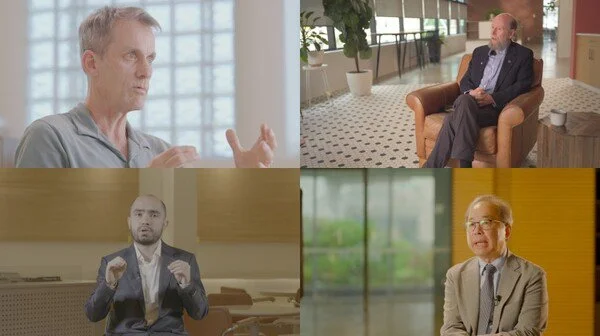
A still from AI Masters Lecture – Next Vision shows, clockwise from the upper left, Jeff Dean, Richard Sutton, Kim Jung-ho and Alex Mashrabov.
Jeff Dean’s three lectures will air from Friday, October 16, through Tuesday, October 20. Richard Sutton will appear on Wednesday, October 21, followed by Alex Mashrabov on Thursday, October 22. Kim Jung-ho’s lectures will air on Friday, October 23, and Monday, October 26. The program airs Monday through Friday at 5:50 p.m.
AI Masters Lecture – Next Vision premiered on September 28, bringing together leading scholars from around the world to examine the AI era from a range of perspectives and provide viewers with essential knowledge. Previous speakers have included Sapiens author Yuval Harari, futurist Ray Kurzweil and Fields Medal recipient Terence Tao.
Jeff Dean traces AI’s development and its potential to expand human capabilities
Jeff Dean, a Google Brain co-founder and former Google chief scientist who led Gemini’s development, will draw on his experience at the forefront of AI research. His three lectures will trace the technological advances and collaboration among researchers that made today’s AI possible, from early neural network research to the transformer architecture underlying modern language models and the creation of Gemini.
Alongside the possibilities of AI that can converse naturally, he will discuss the questions of accuracy and safety that developers face.
Using AlphaGo and AlphaFold as examples, Jeff Dean will examine how AI has changed complex problem-solving and scientific research. He will also explore a future in which AI strengthens human capabilities through tools that support personalized education and scientific discovery.
His lectures will consider what humans and AI can accomplish together. He will emphasize that everyone should be able to access and use AI so that its benefits do not become concentrated among a limited group.
Richard Sutton explores intelligence that learns through experience
University of Alberta professor Richard Sutton, the 2024 Turing Award recipient often called the “father of reinforcement learning,” will examine the nature of intelligence and how AI learns in his October 21 lecture.
His focus is intelligence that goes beyond memorizing large amounts of information or following instructions: the ability to work out independently what actions are needed to achieve a goal. He will explain how reinforcement learning uses the consequences of actions and rewards to find better approaches, much as a baby learns to walk through trial and error.
Richard Sutton will look ahead to an “era of experience,” in which AI moves beyond learning from human-created material to learning through interaction with the world. He will discuss the direction of AI research by comparing approaches that directly instill human knowledge with those that use computing power to enable independent learning.
He will also offer his perspective on “alignment,” the effort to bring AI’s goals into line with human goals, and raise questions about what people need to consider for a future of cooperation between humans and AI.
Alex Mashrabov examines how ideas become video
On October 22, Alex Mashrabov, co-founder and CEO of generative video production platform Higgsfield AI, will discuss how generative AI is changing filmmaking and storytelling.
His lecture will examine how technology that once generated small images has developed into a video production tool, opening opportunities for creators whose ideas previously encountered barriers of cost and technical skill. Examples will include individuals turning their own stories into videos and a single person producing an advertising campaign.
Alex Mashrabov will stress that creating with AI requires more than pressing a button. Producing the intended scene and emotion demands repeated work, a creator’s intent and professional expertise.
He will also address creators’ responsibilities, including copyright and labeling AI-generated material. Viewing AI as an assistant that helps people realize their imaginations more easily and quickly, he will discuss a future in which more people can express their talents through video production.
Kim Jung-ho explains the memory technology behind AI
Kim Jung-ho, a professor in KAIST’s School of Electrical Engineering and a leading international scholar in high-bandwidth memory, or HBM, will discuss the semiconductors supporting AI’s development in lectures on October 23 and 26.
His lectures will explain why fast AI computation depends on more than the graphics processing units, or GPUs, that perform calculations. The speed and capacity of the memory supplying data, and the ability to transfer data between memory and GPUs, also matter.
Through HBM’s structure and development direction, Kim Jung-ho will examine technologies designed to address bottlenecks in AI performance, as well as the opportunities and challenges facing South Korea’s semiconductor industry.
He will also look ahead to an era of AI agents that go beyond answering questions to plan independently, use tools and carry out tasks. He will introduce potential uses for AI agents in semiconductor design and manufacturing, highlighting the relationship in which AI development requires memory innovation while memory development also makes use of AI.
His lectures will explore how AI agents could change working practices and industrial competitiveness, emphasizing the importance of being able to use them and build agents of one’s own.
Produced with budget support from the Ministry of Science and ICT as part of a nationwide AI education initiative, AI Masters Lecture – Next Vision will continue on EBS 1TV every Monday through Friday at 5:50 p.m. until November 6. Episodes will be available after broadcast on the EBS website and EBS e-Sof site (ebssw.kr).
Covers K-pop for KSW Journal, and also writes about Culture and K-Variety.
Comments 0
Comments are currently disabled.