
EBS to air five-part series on Hyeon Taeghwan's nano revolution
EBS will air a five-part series titled "Great Minds: Hyeon Taeghwan's Nano Revolution" starting November 20, featuring the world-renowned nano-scientist.
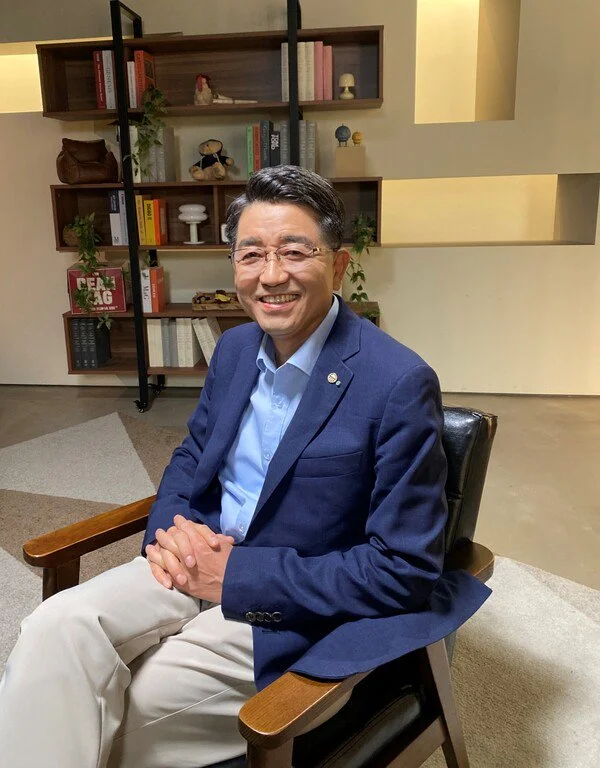
Starting November 20, EBS 1TV will broadcast a five-part series featuring Seoul National University professor Hyeon Taeghwan, who developed technology in 2004 to mass-produce uniform nanoparticles. The program explores how controlling the nanometer world enables advancements in fields ranging from QLED displays to cancer diagnosis and green hydrogen.
Overview of EBS Great Minds: Hyeon Taeghwan's Nano Revolution
Starting November 20, EBS will broadcast the fifth installment of "Great Minds: Hyeon Taeghwan's Nano Revolution" on EBS 1TV at 11:45 p.m. on weekdays. In this series, world-renowned nano-scientist Professor Hyeon Taeghwan will guide viewers into the unfamiliar and fascinating world of nanotechnology. The nano-world holds infinite possibilities. For instance, while gold is typically known to be yellow, it can exhibit entirely different colors when reduced to nanometer size. Semiconductors behave similarly, emitting red, green, or blue light depending on particle size. This opening of the nano-technology world occurs when the common sense of material properties is overturned. Professor Hyeon Taeghwan, a Seoul National University chair professor often cited as a scientist closest to a Nobel Prize in the Korean scientific community, will lead viewers into this invisible nanometer realm. In 1959, physicist Richard Feynman spoke of infinite possibilities at the "bottom." The "bottom" Feynman referred to is the tiny world of atoms and molecules—the nano-world. Once a concept close to imagination, this field began to gain attention as a core area for future industries following the U.S. National Nanotechnology Initiative (NNI) in 2000. Nanotechnology is significant not just because materials can be made smaller, but because controlling structures at the atomic and molecular levels allows for performance and efficiency unattainable with existing materials. The 2023 Nobel Prize in Chemistry awarded to quantum dots demonstrated that the nanometer world is no longer confined to a scientist's imagination. Nanotechnology has already become a reality through technologies such as the vivid colors of QLED displays and catalysts for purifying automobile exhaust, while simultaneously opening new possibilities in research for more precise diagnosis, treatment, and cleaner energy technologies.
The Nano Revolution from Gold Nanoparticles to Green Hydrogen
Professor Hyeon Taeghwan's lectures, which span from gold nanoparticles to quantum dots, QLEDs to nanomedicine, and catalysts to green hydrogen research, demonstrate how the smallest world of science expands into real-world technologies. The EBS Great Minds series, "Hyeon Taeghwan's Nano Revolution," which offers a scientific journey to see the invisible world clearly, will air on EBS 1TV from November 20 to November 26 at 11:45 p.m. on weekdays and will be available for replay on the EBS website. Hyeon is a chair professor in the Department of Chemical and Biological Engineering at Seoul National University, an international member of the National Academy of Engineering, an international fellow of the Royal Swedish Academy of Engineering Sciences, and was selected as a Clarivate Highly Cited Researcher in 2020. As a researcher in nanotechnology drawing global attention, Hyeon serves as the director of the Nanoparticle Research Group at the Institute for Basic Science, leading research to design material properties by precisely controlling the size and structure of invisible nanoparticles. He established a significant trend in nanoparticle research by developing technology for the mass synthesis of uniform nanoparticles at desired sizes. His research leads to quantum dot displays, MRI contrast agents, nanomedicine, catalysts, and green hydrogen technology, showing how the invisible nanometer world expands into practical applications. Related photos are available in the highlights section of the EBS institutional website's cyber PR office on the corresponding broadcast date.
Development of Professor Hyeon's Uniform Nanoparticle Mass Synthesis Technology
In November 2004, Professor Hyeon Taeghwan of the Seoul National University Department of Chemical Engineering developed a technology capable of mass-producing nanoparticles with uniform sizes. Prior to his research results, there were many issues with producing nanoparticles uniformly, at low cost, or in large quantities. Existing methods suffered from non-uniform particle sizes, high manufacturing costs, and environmental issues caused by the emission of toxic substances. The nanoparticle synthesis method developed by Professor Hyeon is expected to further accelerate the commercialization of information, electronics, and medical fields, such as next-generation terabit-class storage media, next-generation displays, and contrast agents for Magnetic Resonance Imaging (MRI). In November 2006, reporters observed the reaction of fluorescent materials with different particle sizes after exposing them to ultraviolet light to reveal the significance of the uniform nanoparticle manufacturing method developed by Professor Hyeon. The program also reproduces the treatment process of magnetic gold nanoshells—a drug carrier made of nano-composites that diagnoses and destroys cancer cells—to introduce how cancer treatment might eventually be resolved through nanometer-sized particles carrying anticancer drugs without a surgeon needing to use a knife. Finally, the series examines the excellent competitiveness of Korean nanotechnology through the research activities of the Creative Research Promotion Group, which was launched in 2002 to secure technologies that contribute to creating new industries like the nano-material industry and enhancing national competitiveness.
Achievements and Academic Evaluation of a World-Class Nanotechnology Researcher
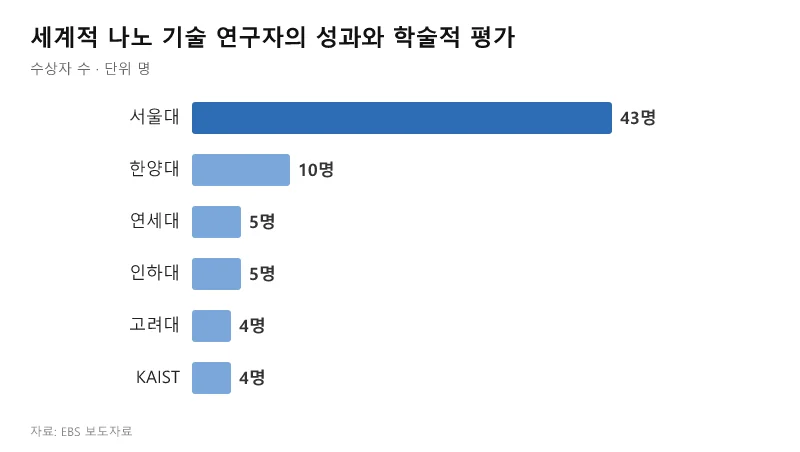
As highlighted at the Seoul Forum in May 2017, Professor Hyeon Taeghwan of Seoul National University is a scientist whose research achievements were recognized early through the Scientist and Engineer of the Month Award in 2002. Furthermore, having already gained a global reputation as an authority on nanoparticle technology, Professor Hyeon turned his attention to the medical field and successfully developed a new nanocapsule in 2008 capable of simultaneous cancer diagnosis and treatment. The table below shows the university distribution of 101 award winners in the engineering field.
| University | Number of Winners |
|---|---|
| Seoul National University | 43 |
| Hanyang University | 10 |
| Yonsei University | 5 |
| Inha University | 5 |
| Korea University | 4 |
| KAIST | 4 |
EBS Great Minds: Hyeon Taeghwan's Nano Revolution will be broadcast on EBS 1TV from November 20 to November 26 at 11:45 p.m. on weekdays.
Covers K-pop for KSW Journal, and also writes about Culture and K-Variety.



Comments 0
Comments are currently disabled.