
AI capabilities surge as global industries adapt to the AGI era
OpenAI researcher Mark Chen discusses the evolution of AI from simple text generation to complex problem-solving, while real-world developments highlight both the immense capabilities and the growing risks of artificial intelligence.
As AI problem-solving rates in the Software Engineering Benchmark soared to 94%, the rapid advancement of technology has triggered significant societal shifts, including a November 2026 incident in South Korea where a top passer of a professional tax accountant exam used generative AI to cheat.
Mark Chen, a key figure who led the development of the image-generating AI DALL·E and the coding AI Codex, and played a central role in adding visual recognition capabilities to GPT-4, was previously introduced by MIT Technology Review as one of the "two people shaping the future of OpenAI research." When Chen joined OpenAI in 2018, researchers were training GPT-2; after confirming that increasing model scale improved performance, they began creating even larger models. AI, which started at the level of generating sentences, has progressed to writing long texts naturally and even creating images, though possessing vast knowledge does not necessarily mean it can solve difficult problems well.
As AI begins to take over researchers' tasks, collaboration methods are changing. AI, which previously struggled with even short coding tasks, is now tackling complex, multi-step operations. While humans provide ideas, AI writes code and assists in experiments, and in cases like mathematician Terence Tao, it helps identify details missed by experts. Humans take on the roles of coordinating various tasks, interpreting results, and determining the next direction. However, as more work is delegated to AI, concerns are increasing regarding cybersecurity, AI dependency, mental health, child safety, and the phenomenon of AI excessively conforming to user opinions. Mark Chen suggested a method of running exams both with and without the use of AI, emphasizing that learning the foundations of mathematics and computer science, reading books, and writing remain important.
Amidst these shifts, South Korean society faced the massive changes brought by AI development in November 2026. An incident occurred where a top passer of the 63rd Certified Tax Accountant Examination, identified as Mr. Han, was investigated after admitting to using generative AI to solve problems via a micro-camera, a modified calculator, and a micro-monitor attached to his clothing. This incident, which saw a surge in high scorers (those scoring 90 points or more) to dozens of times the previous year's levels, demonstrated that the intellectual level required for the nation's highest-level professional certification has already fallen below the average performance of AI. Furthermore, in the realm of popular culture, the song "Did You Become the Adult You Dreamed Of?" (MEOMURU), which implemented composition and vocals using generative AI, became the first such work to reach number one on the Melon TOP100 chart, South Korea's largest music platform. In the Software Engineering Benchmark (SWE-bench), the problem-solving rate of AI has soared from the 40% range two years ago to 94% recently.
| Category | Past Figure | Recent Figure |
|---|---|---|
| SWE-bench problem-solving rate | 40% range | 94% |
| Tencent Hunyuan Hy4 hallucination rate (preview) | 15.76% | 5.45% |
| Tencent Hunyuan Hy4 speculation error (preview) | 23.1% | 5.6% |
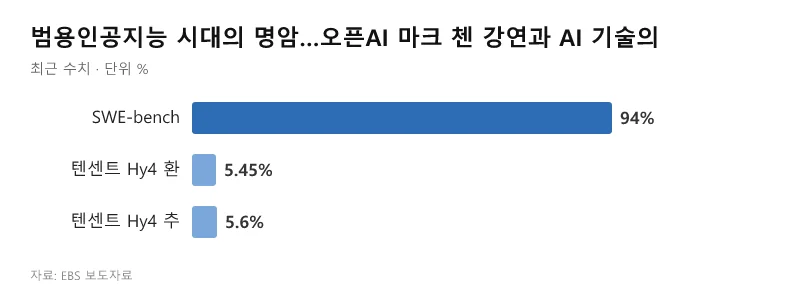
In the Chinese AI industry, various models have been announced in response to the era of agents. On November 2, Tencent released the autonomous research agent Haila 2.0, followed by the official version of its flagship model Hunyuan Hy4 on the 4th. On the 11th, Alibaba released the Qwen4-Max preview, and on the 13th, DeepSeek unveiled an all-in-one API where the server handles tool calls entirely. According to the technical report for DeepSeek V4.1-Flash, the model divides 40 layers into 20 encoders and 20 decoders, reducing the memory capacity per token to 890 bytes. It presented a pricing structure of $0.15 for input and $0.60 for output per 1 million tokens based on a one-hour timeframe, with cache input at $0.003. Completing a 15–20 minute coding session cost $0.14 with a 77% completion rate, while Claude Opus 5.5 cost $5.42 for an 87% completion rate. Tencent announced that for Hunyuan Hy4, the hallucination rate dropped from 15.76% to 5.45%, and unfounded speculation errors fell from 23.1% to 5.6%.
Movements toward Sovereign AI continue globally. The United Kingdom has established a £500 million Sovereign AI fund, Chile is developing open-source models, and Germany's Aleph Alpha has released "Colibri." In the "Independent AI Foundation Model" project promoted by the South Korean government, the SK Telecom consortium presented a large-scale model with 519 billion parameters. However, according to a report released by VANK in March this year, major generative AIs failed to distinguish between East Asian cultures, such as providing Chinese-style palaces or Japanese cherry blossoms when requested to draw Gyeongbokgung Palace. Additionally, according to the "KULTURE Bench" study, the accuracy rate for idiomatic expressions in Korean-specialized models was at the 69% level, and the highest score for poetry problems did not reach 46%.
Changes are also appearing in the field of development tools. Luis Bittencourt-Emilio, Senior Vice President of Product at GitHub, stated at GitHub Universe 2026 held in San Francisco that there is no need to use the most expensive AI models to modify a single line of text on a website, suggesting that different models should be utilized based on task difficulty. GitHub unveiled "Copilot Fusion," which combines multiple AI models to handle development work, explaining that it showed task completion scores 8.7 points higher in major benchmarks and was 77% cheaper compared to using state-of-the-art models. It was found that 61% of Copilot users use multiple AI models, and 63% of paid developers use the automatic model selection feature at least once a month.
EBS Mark Chen's "The AI We Made" will be broadcast on EBS 1TV on weekdays at 11:45 PM from Friday, November 27, 2026, to Thursday, December 3, 2026, and can be rewatched on the EBS website. Related photos can be found on the EBS institutional website's Cyber Promotion Office highlights for the corresponding broadcast dates.
Covers K-pop for KSW Journal, and also writes about Culture and K-Variety.


Comments 0
Comments are currently disabled.