
Professor Cho Hyun-yong to give 4-lecture series from the creation of Hangul to the healing Korean language
EBS Class e will broadcast a special 4-part lecture series titled "The Appeal of Hangul and the Korean Language" by Kyung Hee University Professor Cho Hyun-yong to commemorate the 100th anniversary of the establishment of Hangul Day. The lectures will explore the distinction between Hangul and the Korean language, the principles of Hunminjeongeum, King Sejong's love for the people, and the expressive and healing qualities of the language.
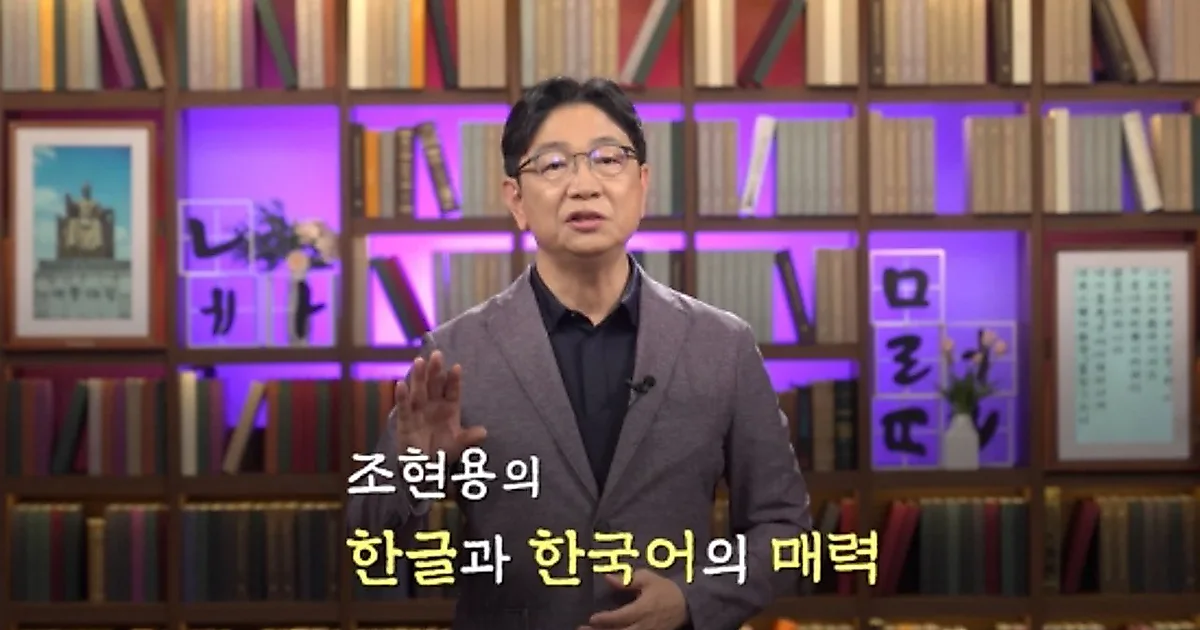
EBS will broadcast Professor Cho Hyun-yong of Kyung Hee University's lecture series, "The Appeal of Hangul and the Korean Language," as a special feature for the 100th anniversary of the establishment of Hangul Day. The lectures will be aired on EBS 1TV on Mondays and Tuesdays at 5:30 AM from October 5 to October 13, consisting of a total of 4 lectures. Starting from the distinction between Hangul and the Korean language, the series will sequentially cover the principles of the creation of Hunminjeongeum, King Sejong's love for the people, the expressions and etymology of the Korean language, and the language of healing. EBS introduced the course as an exploration of the characteristics of Hangul and the Korean language from a linguistic perspective and an investigation into the philosophy of life contained within the etymology of the Korean language.
Lectures starting from the distinction between Hangul and the Korean language
According to EBS, the lectures begin by examining the expression "the Korean language is scientific." The lecture introduction explains that this statement is half right and half wrong. The distinction is that it is not the Korean language that is scientific, but Hangul. By separating and examining the fact that the Korean language is the spoken language and Hangul is the writing system used to record it, the course begins its exploration of Hangul and the Korean language by not confusing language and writing. Rather than explaining the writing system of Hangul and the expressive characteristics of the Korean language together, the structure treats each character separately.
The title of the first lecture is "The Mystery of Hangul's Creation and King Sejong's Love for the People." The course presents the reason why King Sejong created a new writing system 600 years ago as a question, and covers the principles of consonants and vowels, as well as King Sejong's love for the people embedded in the creation of Hunminjeongeum. EBS stated that Professor Cho will use modern linguistics to unravel even the love for the people that King Sejong showed in trying to correct the unfair legal trials of the common people. The lecture is introduced as content that examines both the principles of the creation of the writing system and the intention to care for the people. The center of the first lecture is examining the mysteries related to the creation of Hunminjeongeum from a linguistic perspective.
Korean language that expresses steps and tastes in detail
In the lecture introduction, the Korean language is presented as an emotional language rather than a scientific one. For words describing steps alone, various expressions such as seong-geum-seong-geum, teobuk-teobuk, ajang-ajang, and seulgeum-seulgeum are used, and laughter sounds are divided into haha, heoheo, hoho, and hihi. The characteristic of the Korean language covered in the lecture is that even for the same laughter or step, different sound expressions can be chosen and used. EBS said that it will explain this world of detailed expressions in connection with the unique structure of the Korean language.
Expressions representing taste are also mentioned in the lecture. The taste of "sweet" is variously varied into dalkom-hada, daldal-hada, daljjakjigeun-hada, etc. Through examples of steps, laughter, and taste, the lecture examines how the Korean language is rich in words that express various senses and feelings. EBS introduced that this diversity of expression stems from the high-context culture and the vowel harmony of the Korean language's structure. The course is structured in a way that does not just list the meanings of words, but examines how expressions are used differently and how they relate to the structure of the Korean language.
Examining writing, language, and etymology through four lectures
The broadcast will continue on October 6, 12, and 13, starting with the first lecture on October 5. The titles of each episode contain the creation of Hunminjeongeum, Hangul as seen by people of the world, the characteristics and etymology of our language, and the healing Korean language. The lecture titles by date and the broadcast schedule are as follows.
| Episode | Broadcast Date | Lecture Title |
|---|---|---|
| Lecture 1 | October 5 | The Mystery of Hangul's Creation and King Sejong's Love for the People |
| Lecture 2 | October 6 | Hangul that the world fell in love with, Hangul as seen by foreigners |
| Lecture 3 | October 12 | Exploration of the characteristics and etymology of our language |
| Lecture 4 | October 13 | Embracing words, the healing Korean language |
The second lecture is themed "Hangul that the world fell in love with, Hangul as seen by foreigners." In the following third lecture, the characteristics and etymology of our language are explored, and in the final fourth lecture, "Embracing words, the healing Korean language" is covered. EBS introduced that the task of finding the roots of our language through etymological exploration is connected to finding the way of thinking of Koreans. The four lectures follow a sequence starting from the distinction between writing and language, leading to the perspective of foreigners looking at Hangul, the expressions and etymology of our language, and the healing function of words. The broadcast time is 5:30 AM every Monday and Tuesday.
Professor Cho Hyun-yong's lectures and Class e replays
The lecturer, Professor Cho Hyun-yong, is introduced as a professor who majored in Korean language education at Kyung Hee University. He is the director of the Center for Multidisciplinary Korean Studies and a linguistic culture columnist, and his books include "Koreans' Cultural DNA Through Language" and "Korean Language Speaks of Culture." In this lecture series, Professor Cho deals with the principles of Hangul's creation, the expressive methods of the Korean language, and the meanings embedded in its etymology. EBS explained the theme of the course as a process of discovering the philosophy of life and the language of healing contained within the etymology of the Korean language.
EBS is a knowledge and culture program that started in 2020. EBS introduces it as a program that delivers knowledge and insight that penetrates the times through lectures by experts in each field. This "The Appeal of Hangul and the Korean Language" consists of a total of 4 lectures and will be broadcast on EBS 1TV from October 5 to 13 on Mondays and Tuesdays at 5:30 AM. After the original broadcast, it can be watched again on the EBS Class e website.
This lecture series, prepared as a special feature for the 100th anniversary of the establishment of Hangul Day, starts with the first broadcast on October 5 and continues to the fourth lecture on the 13th. Viewers can watch the lectures by episode on EBS 1TV, and after the broadcast, replays can be used on the Class e website. The lectures sequentially cover the distinction between Hangul and the Korean language, the principles of creation and love for the people, the expressions and etymology of our language, and the healing Korean language.
Covers K-pop for KSW Journal, and also writes about Culture and K-Variety.

Comments 0
Comments are currently disabled.