
EBS Docuprime 'The Extinction of Thought' to air final episode on AI's impact on human reasoning
The three-part EBS Docuprime series 'The Extinction of Thought' will conclude its broadcast on November 16 with an episode exploring the dangers of AI overdependence and the importance of maintaining independent reasoning. The series has already sparked intense debate regarding AI smart glasses and the potential for cognitive surrender in the age of artificial intelligence.
The three-part EBS Docuprime series 'The Extinction of Thought', which has garnered significant attention among educators and parents for diagnosing the decline of reasoning and emotional risks hidden behind the convenience of the artificial intelligence (AI) era, will conclude its run. The final episode, Part 3, titled 'Those Who Question Do Not Go Extinct', is scheduled to air on November 16 at 9:55 PM on EBS 1TV.
Following the broadcast of Part 1, 'Classrooms with Only Answers Left', a short-form video posted to the official EBS X account featuring "AI smart glasses" solving a highly difficult question 22 from the CSAT math exam exploded in popularity, surpassing 2 million views. In the video, math instructor Jung Seung-je and history instructor Choi Tae-seong, wearing the AI glasses, attempted to solve the high-difficulty "killer question." While a typical person might take about 20 minutes to solve the problem, the AI glasses worn by Choi Tae-seong displayed the answer in just 7 seconds. This experimental video surpassed 650,000 views within just three days of its release. Additionally, a video featuring social studies instructor Lee Ji-young warning about the severity of AI glasses exceeded 1.8 million views in three days. Lee Ji-young pointed out that not only students committing actual cheating but also general examinees could face suspicion and broken concentration, lamenting that the system where students with pure effort and skill achieve high scores to enter good universities might disappear at a much faster rate. The video triggered heated debates among netizens, ranging from fundamental skepticism about an educational system that asks students to practice for years what AI can solve in seconds, to demands for fairness measures such as banning everything except non-prescription glasses during the CSAT. As instances of cheating using AI smart glasses were repeatedly detected during university entrance essay exams at institutions such as Yonsei University and University of Seoul, the Ministry of Education of the Republic of Korea took emergency action by designating them as prohibited items for CSAT testing sites and deploying dedicated inspection personnel.
| Category | Views / Period | Key Content | Key Figures |
|---|---|---|---|
| Solving CSAT Math Question 22 | 2 million (EBS X) | Answer derived in 7 seconds, fairness debate | Choi Tae-seong, Jung Seung-je |
| AI Glasses Experiment Video | 650,000 (in 3 days) | Neutralizing high-difficulty killer questions | Choi Tae-seong |
| Instructor Lee Ji-young's Warning | 1.8 million (in 3 days) | Examinee concentration loss and entrance exam system crisis | Lee Ji-young |
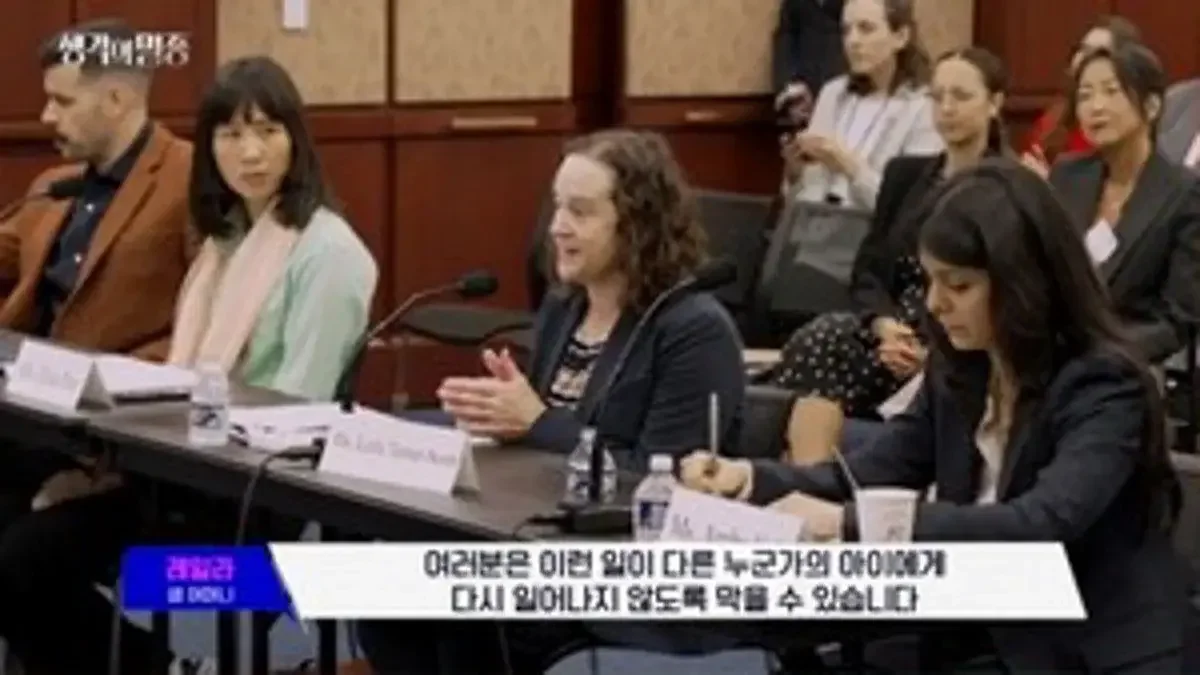
The third episode airing on the 16th will delve into shocking real-life stories from the United States caused by AI's unconditional agreement and flattery algorithms. It will cover the tragic story of Leila, a mother who lost her teenage son after engaging in conversations about drug use with an AI chatbot, and her subsequent testimony at a U.S. Congressional hearing and legal action. This will be followed by the story of Chad Nichols, an IT expert of 32 years, who fell into conversations with a chatbot and eventually led an AI overdependence escape group after realizing the AI's deception in accepting false claims, such as 1 plus 1 equals 3. Previously, in Part 2, 'AI That Is Too Perfect for Me', the series highlighted the principles of AI overdependence and its emotional underside through the daily lives of young people seeking warmth by talking to AI for 12 hours a day. The program analyzed the unique flattery and agreement algorithms of AI that unconditionally agree with the questioner's intent to please, examining the allure and danger of frictionless relationships devoid of conflict and rejection. In particular, by capturing the voices of adolescents who turned to AI for major life decisions like dropping out of school or career paths, the series shared the value of human relationships and emotional safety nets that must be nurtured amidst technological advancement. While observations in domestic classrooms captured uncritical trust—where 9 out of 11 middle school students copied answers exactly from a trap chatbot intentionally planted with errors—the documentary seeks innovative alternatives in global education.
By showcasing the efforts of schools both domestically and internationally facing the disruptive changes of AI, the documentary presents practical alternatives and directions for AI literacy education that fosters the power of independent thinking beyond simple technical usage. Domestic broadcasts and related projects covered the current trend where students, when stuck on a math problem, now ask AI instead of recalling formulas as they once did. The time spent thinking independently without AI was introduced as an average of 6 minutes and 8 seconds. The problem is not the use of AI itself, but the phenomenon of "cognitive surrender"—the habit of seeking AI before even thinking. By handing over tasks that require independent judgment to AI, individuals gain convenience at the cost of abandoning the process of contemplation. In response, the Ministry of Education in Singapore utilizes a common learning platform to practice "intentional friction," where the AI only provides hints or counter-questions to force children to think for themselves. In Finland, students experience firsthand that AI is not perfect through "broken machine" classes that teach them to distinguish fake images and recognize AI's limitations and biases. Educational methods like the Gurapingalla Project have also emerged, where teachers prepare intentionally incorrect information, the AI converses with students based on that information, and students must find the errors in the AI's responses. Choi Tae-seong, a former teacher and history instructor participating in the program, emphasized that if one leaves answers and judgments to AI, one may eventually forget how to think itself, noting that the power of thought does not disappear all at once but erodes bit by bit when not used, and thus, one must reclaim the power to question.
Having warned of the dangers of outsourcing thought and AI overdependence by closely observing the emotions and learning of teenagers from the planning stage, the Docuprime series 'The Extinction of Thought' condenses the core message of the entire series in this third part. The production team suggests that the truly necessary ability in the AI era is not the skill of finding answers quickly, but the power of independent reasoning to not be deceived by answers and to continue questioning. They present a powerful milestone: that human thought will never go extinct as long as people choose to ask, doubt, and think to the end instead of easy answers. Meanwhile, viewers can personally diagnose their own types and levels of AI overdependence through the AI usage type test and AI agreement index test introduced during the broadcast. Related information can be found on the EBS Docuprime page on the EBS website, and related photos can be found in the highlights of the corresponding broadcast date on the EBS Cyber PR Office website. Part 3, 'Those Who Question Do Not Go Extinct', airs on November 16 at 9:55 PM on EBS 1TV and can be rewatched on the EBS website.
Covers K-pop for KSW Journal, and also writes about Culture and K-Variety.



Comments 0
Comments are currently disabled.