
EBS science talk show to explore star deaths and element origins
The EBS science talk show "Science as a Hobby" will explore the connection between the death of stars and the origins of elements essential for life, including phosphorus, in its upcoming broadcast.
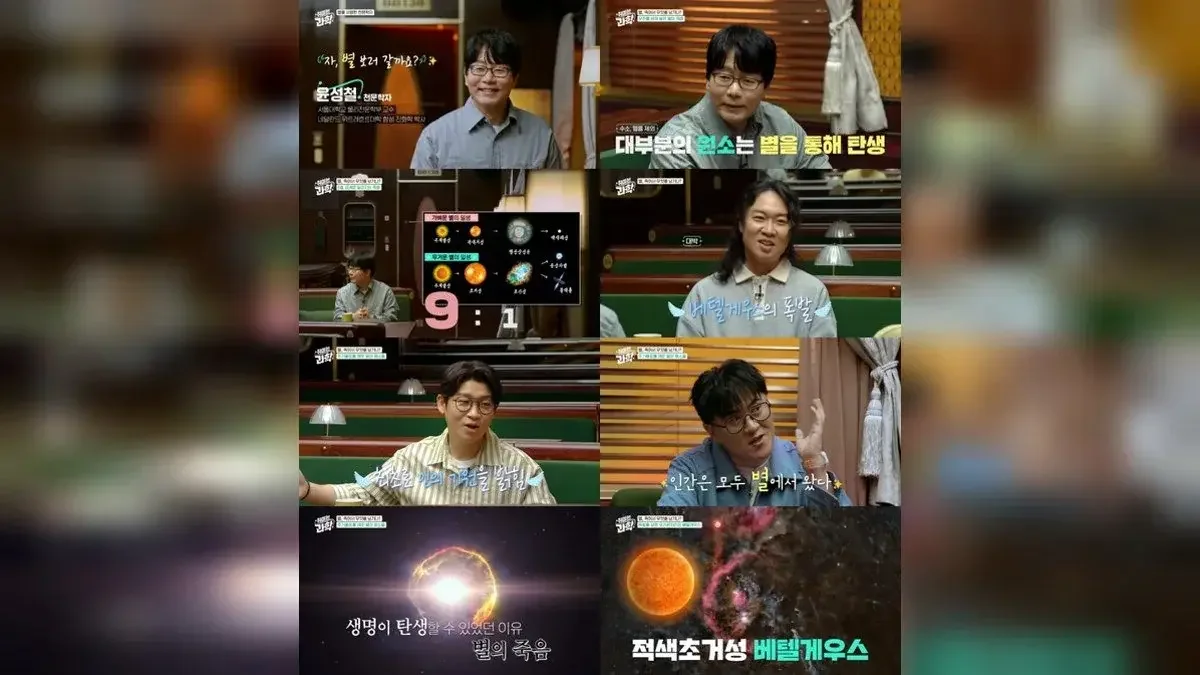
The EBS program "Science as a Hobby" will broadcast on October 30, 2026, to discuss how supernovae create elements like phosphorus. Professor Yoon Seong-cheol will join the cast to examine the life cycles of stars, including the possibility that Betelgeuse could explode in the near future.
Where does the matter released by a dying star go, and how were the elements necessary for life created? In a broadcast on October 30, the EBS science talk show "Science as a Hobby" will examine the death of stars and the origins of elements. MC Defconn, science communicator Hangseong, Professor Jang Hong-je, and Professor Jeong U-hyeon will meet Professor Yoon Seong-cheol from the Department of Physics and Astronomy at Seoul National University to discuss the end of stars and what they leave behind in the process.
The program begins with horoscope readings based on the cast members' zodiac signs before transitioning into the life cycles of stars. Professor Jang Hong-je will interpret the horoscopes, and science communicator Hangseong will introduce Professor Yoon to discuss the birth and death of stars. Starting from the premise that while zodiac signs are familiar, the actual life cycles of stars are not deeply understood, the show is structured to examine the relationship between the death of stars and life on Earth. The broadcast will cover how a star's end varies depending on its mass, supernovae, kilonovae related to the creation of gold and platinum, and the possibility of Betelgeuse exploding.
From zodiac horoscopes to the life of stars
In the early part of the broadcast, Professor Jang Hong-je will interpret the zodiac horoscopes of the cast, an segment EBS introduces as the "Dark Chemist Taste" horoscope. Science communicator Hangseong will then introduce Professor Yoon Seong-cheol from Seoul National University's Department of Physics and Astronomy to discuss the birth and death of stars. Defconn, Hangseong, Professor Jang, and Professor Jeong U-hyeon will join Professor Yoon to ask about the matter left behind after a star dies and its relationship to us.
Professor Yoon will explain the process of how the death of a star is connected to the creation of elements through the periodic table. EBS reported that the death of a star is a core part of the process where elements are created and dispersed into the universe. The program highlights that stars are not merely celestial bodies in the distant universe but are linked to the origins of materials necessary for life. Based on this explanation, the broadcast will examine the life of stars alongside the origins of humanity.
The origin of phosphorus found in supernovae
Phosphorus is presented as a specific case study of an element. Although phosphorus is a very rare element in the universe, it is essential for life and is used in DNA and ATP, as well as in bones and teeth. According to EBS, Professor Yoon participated in research that provided observational evidence that phosphorus is created from supernovae. The explanation states that the event of a star ending its life in an explosion is linked to the origin of phosphorus. The broadcast will cover the creation and dispersion of elements, examining the process by which matter created from the death of stars is used by living organisms.
Upon the introduction of Professor Yoon's research participation, Defconn remarked, "We are children made by stars." The program connects the creation of phosphorus to the death of stars to explain the origin of the materials that make up our bodies, noting its use in bones, teeth, DNA, and ATP. EBS promotional materials explain that the research provided observational evidence that phosphorus is created in supernovae, and the broadcast will elaborate on how the death of stars is involved in the creation and cosmic dispersion of elements. Using phosphorus as a case study, the program will examine the relationship between stars and life while also covering how other stars meet their ends.
The end of a star varies by mass
Not all stars die in the same way. The broadcast explains that the ends of relatively light stars, like the Sun, differ from heavy stars that are at least 8 times the mass of the Sun. Small-mass stars leave behind a white dwarf as a remnant after completing nuclear fusion. In contrast, massive stars end their lives by triggering a supernova explosion.
A star's lifespan also varies greatly depending on its mass. Massive stars have very short lifespans due to intense nuclear fusion reactions, while small-mass stars can live much longer than the current age of the universe, which is 13.8 billion years. The broadcast poses the question of why lighter stars live longer, though EBS promotional materials do not provide a specific explanation for the reason, presenting it instead as content to be covered in the program.
| Value | Content presented in the data |
|---|---|
| At least 8 times | Classification of heavy stars based on the mass of the Sun |
| 13.8 billion years | Current age of the universe |
People waiting for the Betelgeuse explosion
The broadcast will also cover the possibility of a supernova explosion of the red supergiant Betelgeuse. Professor Yoon and science communicator Hangseong express their wish to witness the explosion of Betelgeuse directly. EBS introduced that there is a possibility that Betelgeuse could explode in the near future. Betelgeuse is located as a point in the constellation Orion, and it is explained that if this star explodes, the observed shape of the constellation Orion may change.
Professor Yoon stated, "The subject of astronomy is history," noting that we are also part of that history in a constantly changing universe. Defconn responded, "Let's all gather together when Betelgeuse explodes." Using the possibility of the Betelgeuse explosion as a catalyst, the program will continue the story regarding the process of how stars change and die, and how those changes are observed. EBS stated that this broadcast will examine both the death of stars and how it leads to the birth of new stars and new life.
"Science as a Hobby: 'What do stars leave behind when they die?'" will be broadcast on EBS 1TV on Friday, October 30, 2026, at 10:50 PM. Professor Yoon Seong-cheol, Defconn, science communicator Hangseong, Professor Jang Hong-je, and Professor Jeong U-hyeon will appear to discuss the origin of phosphorus, the end of stars, and the possibility of the Betelgeuse explosion.
Covers K-pop for KSW Journal, and also writes about Culture and K-Variety.
Comments 0
Comments are currently disabled.