
Matsutake at 1.7 Million Won a Kilo and 1,500 Burning Charcoal Bags: EBS Takes in Autumn From Mountain to Sea
EBS1's five-part "Korean Journey: Ripening Autumn" airs nightly from October 19 to 23, visiting Gapyeong, Andong, Seocheon, Odaesan and Yangyang County. It follows pine nut pickers, shad fishermen, a veteran barber and matsutake hunters.
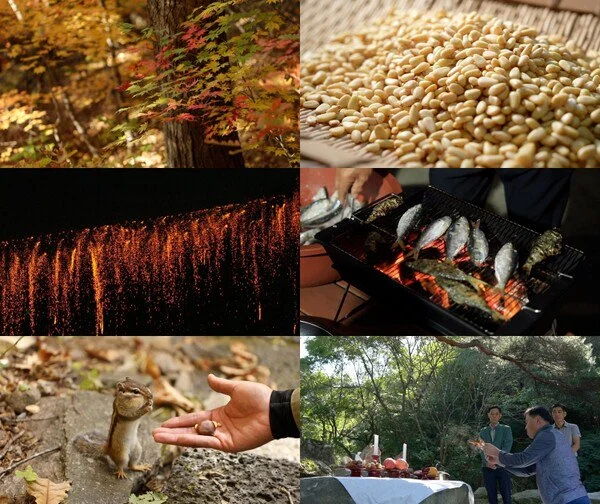
A matsutake that reportedly fetched 1.7 million won per kilogram in Yangyang County, and a 250-metre rope hung with 1,500 burning charcoal bags over the Nakdonggang River, anchor EBS1's "Korean Journey: Ripening Autumn". The five-part series airs nightly at 9:35 from October 19.
EBS says the programme visits five places: pine nut picking on Gapyeong's nut pines, the Seonyu Fireworks Festival at Hahoe Folk Village in Andong, shad fishing off Seocheon, an autumn-foliage hike on Odaesan, and matsutake gathering in Yangyang County. Along the way it follows the work and journeys of the people it meets, among them a pine nut harvester who climbs 20-metre trees, shad-boat crews, and the actor Ahn Hong-jin, who visits Odaesan. Episode one covers the Gapyeong pine nut harvest and pine nut handmade tofu, episode two the Andong market and Hahoe Folk Village, and episode three shad fishing off Seocheon. Episode four brings in the forest path at Woljeongsa Temple and the Odaesan hike, and the finale shows matsutake-gathering preparations in Hakhyeon Village in Jecheon and a matsutake hunt in Yangyang County.
Fire over the river, and a barber's chair, in Andong
The Seonyu Fireworks Festival, which appears in the second episode, "Village Where Fire Rains" (October 20), is said to descend from a pastime scholars enjoyed about 450 years ago, floating boats and reciting poetry. The tradition once lapsed, but EBS explains that villagers studied old documents and went through 17 or 18 rounds of trial and error to light the fire again. Residents grind charcoal, salt and mugwort finely and roll them in hanji paper to make charcoal bags. 1,500 of the bags hang from a 250-metre line linking Buyongdae with the far side of the river. At night each bag is lit, and sparks scatter across the sky over Hahoe Folk Village, which the Nakdonggang River encircles.
Before that, Ahn Hong-jin tours Andong's five-day market and the people he meets there. Giant octopus sold in this inland city's market is presented as a market highlight, and the broadcast links it to Andong's culture of honouring ancestors and hosting guests. At the market he also meets the barber Kim Ok-yeon, who picked up her scissors and entered the male barbers' domain in the 1960s, when female barbers were rare, and has kept her shop for 59 years. Ahn gets his first barbershop shave there, has his beard and facial down trimmed, and then receives a massage.
Chasing gizzard shad at 60 km/h off Seocheon
When a school of gizzard shad is spotted, a boat circles at 60 km/h while spreading its net around the fish, and on one side a bell is rung to keep the shad from escaping. The catch goes to waiting live-fish trucks at the port and on to destinations nationwide. According to the broadcast, wild shad live only a day or two after being caught, so they skip the auction and go straight onto the trucks. After the work, the crews eat shad sashimi and grill shad over charcoal. EBS says the fishermen go out two or three times a day, timed to the tides.
The third episode, "Battle of the Gizzard Shad" (October 21), follows the boats off Seocheon in autumn. EBS says the shad appear in schools and vanish just as fast, so boats roam the sea looking for them. More than twenty boats fish in shad season, and when word comes that shad have shown up, they race off to set their nets first. Captain Choi Cheol-gyu, with 30 years' experience, also goes looking. Fishermen explain that shad were hard to find this year, and the programme shows boats arriving after another has already taken the catch, and schools scattering within moments.
Pine nuts from 20 metres up in Gapyeong
Harvested cones do not become edible pine nuts right away. The hard-shelled cones go into a threshing machine to separate the kernels, which are dried in the sun for about four days before the shells are removed. EBS reports that pine nuts sell for 150,000 won per kilogram. After the mountain harvest, the broadcast turns to a couple who make pine nut handmade tofu. They light a wood fire under a cauldron inherited from the wife's or husband's late mother, and use a touch they learned by watching over shoulders since childhood. Pine nuts go throughout the tofu, and the programme goes on to show a hotpot being simmered with the pine nut tofu. One episode thus takes pine nuts from mountain harvest through processing to the dinner table.
The harvest itself is the work of Bae In-taek, who, according to EBS, climbs and descends the nut pines of Gapyeong's mountains each autumn to pick the cones. He has been doing so for 46 years. He wears spiked climbing gear on his shoes, digs into the trunk as he ascends, and from the tree extends a 12-metre pole to shake down cones from neighbouring trees. The working height is about 20 metres, and the programme also shows him dropping cones from the treetop, climbing down and gathering those on the ground.
A night in a mountain temple on Odaesan
In the fourth episode, "Autumn Face of Odaesan in Rouge" (October 22), Ahn Hong-jin visits Odaesan in Gangwon State. The journey begins on the forest path to Woljeongsa Temple, where he meets Venerable Seonjae, a master of temple cuisine, cooks with seasonal autumn radish and carrot, and tastes carrot noodles. On the path he also meets practitioners performing Three Steps, One Bow, bowing once for every three steps. Climbing on, he encounters leaves turned yellow and red, squirrels that approach to eat the pine nuts and sunflower seeds in his palm, and a small bird carrying off food. At Jungdae Sajaam he visits Jeokmyeolbogung, which enshrines the Buddha's relics, and hears from the head monk, Venerable Seong-eom, about the wisdom of calming the mind.
With dusk making it hard to reach Birobong, Ahn spends the night at the temple thanks to the monk's kindness. At dawn he heads for the 1,563-metre peak to see sunrise and a sea of clouds, climbs steep stairs to the summit, and watches the clouds lift to reveal the ridges and foliage.
Matsutake hunting in Jecheon and Yangyang County
The finale, "A Mushroom for 1.7 Million Won?" (October 23), is about the search for matsutake. The working group of Hakhyeon Village in Jecheon holds a rite praying for a good harvest and safe gathering, and strings a 6-km no-entry rope to keep outsiders from picking illegally. Residents are also shown guarding the mountain during the season. In Hakhyeon Village, however, no rain has fallen, the mountain is dry and no matsutake are coming up.
The programme then moves to Yangyang County in Gangwon State, where news arrived that a kilogram of matsutake had sold at auction for 1.7 million won. There, with Lee Seung-ho, who has 15 years of matsutake-gathering experience, it climbs the mountain to find mushrooms hidden among pine needles and fallen leaves. EBS says matsutake can be found only during a short span in autumn, and spotting them takes long experience and a keen eye.
"Korean Journey: Ripening Autumn" airs on EBS1 every night at 9:35, from Monday, October 19, to Friday, October 23. The five episodes run from the Gapyeong pine nut harvest through Andong, Seocheon and Odaesan to the matsutake hike in Yangyang County.
Covers K-pop for KSW Journal, and also writes about Culture and K-Variety.

Comments 0
Comments are currently disabled.