
Black Sea Highland Villages, from Wooden Car Races to 12m Aerial Houses (9.14~17 EBS1)
This documentary series explores the unique culture and breathtaking landscapes of northeastern Turkey…
World Theme Travel: Northeastern Turkey, Tracking the Rumors
A charm completely different from the dry and exotic landscapes of Istanbul or Cappadocia! High mountains such as the Kaçkar Mountains continue along the Black Sea coast, and plateaus at altitudes of around 1,000 to 2,800m are spread everywhere. In summer, it is a heavenly paradise covered in a green carpet and a sea of clouds. However, due to the rugged terrain and climate, access is not easy, so not much is known. Therefore, we meet the even more interesting northeastern Turkey.
The 'engine-less' wooden car racing competition Formulaz—does the landscape change every ten years?! What is the Whistle Village like now? Giresun's village where people live for only three months, Koçdüzü Plateau, and Anzer Plateau, a global source of honey and a land of natural medicinal herbs.
We head to northeastern Turkey, a home higher than the clouds.
* Broadcast Schedule: September 14 (Mon) ~ September 17 (Thu) at 8:40 PM, EBS1 * Curator: Jang Ju-young, PhD in Turkic Linguistics. After learning Turkic languages out of accidental curiosity during university and falling in love with its charm while traveling Turkey for a month, she decided on a career in Turkic language research. Having resided locally for 7 years, she obtained her Master's and Doctoral degrees from Hacettepe University in Ankara, and has published three textbooks by explaining Turkic language and culture from a Korean perspective.
Part 1. The Talked-about Scenery, Really? - September 14 (Mon)
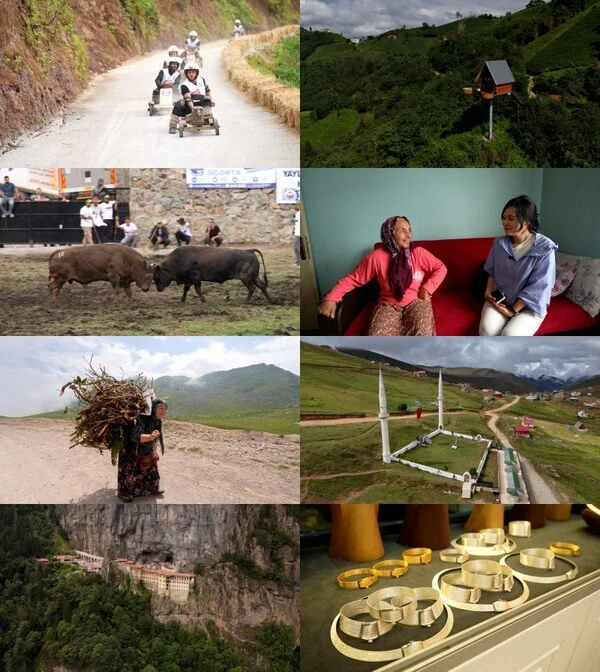
In Tunca, Rize Province in northeastern Turkey, the wooden car racing competition 'Formulaz' is held every summer. This competition, where participants race down green tea plantations in wooden cars they built themselves, was named by combining the name of the global Formula 1 racing competition and the Laz people, the indigenous ethnic group of this region. To participate, the wooden cars must be handmade and strictly follow the specifications: length under 170cm, width 70cm, and wheel height 25cm. Since there is no engine, they can only go downhill; they look like toys, but the top speed is as high as 80–90km/h. What started as a game for children in this region has become a tradition. It is conducted only in male and female divisions, but this year, a senior division for those aged 45 and older was newly established. Who will be this year's winner? A place visited after hearing rumors of a house floating in the green tea fields! Indeed, far away on a green tea field hill, a house is floating! The owner, Mr. Muhammet, gladly shows around his house. It was his dream to build a truly wonderful house. In the two-story house built on pillars 12m high, there is everything from a TV, refrigerator, sofa, and bed to hot water in the bathroom and kitchen. Mr. Muhammet completed the house after researching the design for five years and having it reviewed by experts. He plans to install a jacuzzi on the balcony in the future. We peek into his dream house, which he wants to make more perfect for his three young children. The next place visited is a village in Çamlıhemşin. It is said that a round wooden barrel is an essential item for every house here. This is the Karakovan, a beehive where hollow wooden barrels are placed on trees so that bees can produce honey naturally. It is a traditional method used since before beekeeping technology was developed. Mr. Mustafa (76), who has been doing Karakovan for 55 years, carries an empty wooden barrel on his back, pushes through lush mountain paths, and installs it on trees over 10m high; this is his own know-how to protect the honey from bears. It is an organic method that produces honey relying purely on nature without any human intervention! What does that honey taste like? The last place visited is a mountain village where there is only one resident. Mr. Matin, who was born here and returned to his hometown after living elsewhere, has solved transportation problems by installing a cable car himself, and continues a self-sufficient life by growing potatoes and raising chickens. To protect his disappearing hometown, he is building a treehouse in the mountains and providing space for visitors to stay. We feel the romance of the treehouse in the dense mountains that brings peace to the heart.
Part 2. I Really Wanted to See It, Whistle Village - September 15 (Tue)
The Black Sea highlands of Turkey are bustling with various festivals in the summer. Especially in Artvin, where the altitude exceeds 1,200m, Boğa Güreşleri (bull wrestling) is held in various places. It originated from the agricultural culture of pitting bulls against each other to decide the leader of the herd when driving cattle up to the highlands in summer. Unlike Spanish bullfighting, it is a unique tradition that strictly prohibits animal cruelty and respects the natural instinct of the bull. The competition proceeds in a tournament style, dividing them into classes based on the bull's weight. Dayli, who is participating for the first time this year, is 4 years old. His owner trained him like an athlete, feeding him grain and taking him for walks for this match. Dayli's debut stage, dreaming of being a champion despite it being his first time! Actions that cause bleeding are strictly prohibited! If one bull is pushed back or runs away due to strength, the match ends immediately. Who is the winner of the match? There has been a famous village in the Turkish Black Sea for a long time. It is the so-called 'Whistle Village', Kuşköy, where people communicate by making bird sounds with whistles. It is said that whistle language was a major issue even in linguistics. They say the landscape changes every ten years, but do they still use whistle language even now when mobile phone use is common? Thus, the production team returned to the village after 10 years! The village is in the middle of the harvest season. The mountains are full of people picking hazelnuts. Introduced by the village head, Mr. Yakup, we tour the village, and whistle sounds are heard continuously from everywhere. It is said that 80% of the residents still use whistle language. Curious about its delivery, we gave three action missions to a person 1–2km away. What was the result? There were people we really wanted to meet in this village: the residents who appeared on 10 years ago. Mr. Muazet, who appeared with his father in the previous broadcast, was delighted to see the production team again, saying they had promised to return. Although she bought a mobile phone, she hardly looks at it, to the point where she doesn't even know if it's turned off. For Ms. Muazet, whistle language is still the best means of communication. In the past, when they raised many livestock, it was used to communicate with each other in the mountains, but with the decline of the livestock industry and the development of mobile phones, young people these days have almost no reason to use whistle language. Chaadash, who is the best at whistle language even among children, is the village head's great-grandchild. After having a delicious lunch, a battle suddenly broke out between the village head, his nephew, and his great-grandson Chaadash to see whose whistle sound is the loudest. What responded to it was the dog outside! It is surprising that even animals can understand whistle sounds. During the 2 nights and 3 days staying in Kuşköy village, we practice intermittently to say 'Hello' in whistle language. Will they be able to say goodbye in whistle language?
Part 3. Living for Only Three Months - September 16 (Wed)
The journey begins in the Görele region of Giresun Province, tasting the delicacy of the Turkish Black Sea, the traditional pizza called Pidesi. Unlike regular open-style pide, the Görele traditional style wraps the top with dough to make it round or like a boat-shaped 'pocket'. Instead of cutting it with a knife and fork, you tear the crispy edges with your hands and dip them into the center where the cheese, butter, and egg yolk are melted. The Black Sea highlands in summer are lively due to people coming up from the lower villages with their livestock. This is the traditional Yaylası culture of moving livestock to the highland pastures with fresh grass to avoid the heat of the lower villages. Their highland life usually lasts for 3 months! Koçdüzü Yaylası, at an altitude of 2,400m, has been used for generations by the residents of the Laz people, an indigenous ethnic group of the Black Sea coast. Residents from 5–6 lower villages come up, and the government provides houses to the residents engaged in livestock farming. In small, sturdy traditional houses built of wood and stone, they make cheese, butter, and yogurt from freshly squeezed raw milk; the flavor is superior because it is made from the milk of livestock that grew eating the wildflowers and grass of the highlands. The dairy products made at this time become the main food and source of income for the residents during the winter. We join the daily life of Mr. Bayla and Ms. Zayde, house owners who release the cows into the pasture in the morning and milk the cows and goats in the morning and evening. The weather changes rapidly as expected of the highlands. It gets very foggy and eventually starts to rain. What do people do in the highlands when it rains? We peek into the highland life on a rainy day, from the Three Sisters grandmothers who live next door and are together almost all day, to the teenage girl who comes up every vacation to help her grandmother and grandfather, and the resident who treats a wounded horse's leg with medicinal herbs. As an Islamic country, mosques can be easily seen in every highland. Is there an outdoor mosque with no walls or roof? The place we visited after hearing that rumor is Kadırga Yaylası. It is said to be a place where Fatih Sultan Mehmet, the conqueror of the Ottoman Empire in 1461, stopped on his way to conquering Trabzon and prayed outdoors with his soldiers. It still presents a magnificent view to this day. People gather from all over the country to attend the worship held every Friday in the summer. There is a superstition that it never rains when they are worshipping. Is it the Truth?
Part 4. The Scent of a Great Life - September 17 (Thu)
The Kaçkar Mountains, called the 'Alps of Turkey'. Anzer Yaylası, at an altitude of about 2,100m, is covered with thousands of species of wildflowers in the summer, and residents pick the blooming flowers and grass to use for cooking, tea, and medicinal herbs. Mr. Paşat, who is sixty this year, stir-fries freshly picked Isırga (nettle), Gelin parmağı (red broom mushroom), and Ebegümeci (mallow) to eat with eggs, and applies blanched herbs to joints that ache. This is a folk remedy passed down over many years and a way residents maintain their health. Originally, Anzer Plateau is a world-famous producer of Anzer honey, and many people visit Anzer Plateau for their health after hearing rumors about the natural medicinal herbs. While walking through Anzer Plateau, we encountered a flock of as many as 600 sheep. The person looking after all these sheep alone is Mr. Süleyman. Having herded sheep for 50 years following his grandfather and father, he climbs up and down steep mountain paths fearlessly in rubber shoes. He especially cherishes the 'Osmanlı koçu' (Ottoman ram) which has four horns; it is considered a sacred animal that is the leader of the flock and protects the family's prosperity, with a lineage continuing from the Ottoman Empire era. We listen to the philosophy of Mr. Süleyman, who does not sell it for food but cares for it sincerely to continue the lineage because he knows its value. In Trabzon, there is a traditional handicraft considered the best wedding gift in the Black Sea, which is Trabzon Hasırı. It is a technique of weaving gold and silver threads as thin as hair to make jewelry, inspired by the armor worn during wars. It continues only in Trabzon, and when a necklace, ring, and bracelet are all completed, the price is more than 20 million Korean Won! Surprisingly, the ones continuing this delicate technique are rural women. Ms. İlyaoju has been making Hasırı for nearly 40 years in Balıköy. She works in small groups with village women, chatting, and when the work is finished, they spread out the food they brought and eat together. The female artisans feel pride in their respective hand skills. It is said to be a traditional technique passed down from mother to daughter without separate schools or educational institutions. Although it is a demanding and hard task, the thread of tradition continues. The next journey heads to Sümela Manastırı, located at the edge of a steep cliff. It is a historical heritage that began to be built by Greeks in the 5th century and has endured a thousand years. Even through the historical upheavals where the ruling class changed through the Ottoman Empire, its majesty remains unchanged. We feel the overwhelming emotion given by the massive architecture harmonizing with the dizzying rocky terrain and conclude the journey.
* Related photos are on the EBS institution website (about.ebs.co.kr)-Cyber PR Office-Highlight, on the corresponding broadcast date.
◆ At a Glance
· Publishing Institution : EBS
· Category : World Theme Travel
· Distribution : September 13
Source : EBS Press Release
The Korea Social Welfare Journal is striving to deliver press releases and welfare information more easily and accurately with the help of AI technology.


Comments 0